Nnamdi was one of those men that lived for every minute. He had no care for the future.
Once, he told his friends that to think too much about the future was like concentrating so much on the kind of food a wife was preparing at home, while you were out with your friends drinking ngwo – to think like that could give a man headache and early heart attack, for when you wanted egusi soup, she could decide to prepare achara, which was your worst meal. That was how Nnamdi thought, in fact, he once gave all his month’s earning to a woman he picked by the roadside, who had just told him that she was abandoned by her man and she had a baby at her breasts. Tell me, what kind of man would do that these days? Knowing that women were created to come to the world and tell lies to men to get by?
Nnamdi lived in a two room apartment, sparsely furnished, and ate out mostly. In fact, he owned no stove, or cooker or pots or cutleries. What was the use? He would ask you if you visited him. His apartment had four plastic chairs, the very cheap ones, the kind that a child would decline sitting on, there was a glass centre table in his sitting room, and a mattress on the floor. Just a mattress and a huge bag that contained his cloths, all of them, there was no hanger, none of such. He didn’t own anything his mates had in their homes, if where he lived was to be called a home, for home was a place where one returned to for rest and leisure and peace of mind. In his house there was no peace of mind, in the evenings, his father’s ghost would visit him, whether the ghost came to haunt him or to be with him, no one could tell, but what all his friends knew was that a certain ghost, whom he claimed was his father’s lived in his house.
Each time he returned from work, usually, he returned close to midnight, because from work he would visit the beer-bars, he knew all the bars in town, so whenever he returned, he would vomit in his tiny toilet and sleep on the floor of the toilet if he was too drunk to get to the room. He could sleep, sitting on one of the plastic chairs or on the floor or standing, reclining on the wall. He could do that. It was that pathetic. Let me not bore your curiosity anymore with this wretched fellow for you may not understand what he was passing through, if your father had never gone to some juju, seeking to become wealthy, without any money on him but borrowed some money from the juju men to buy the sacrificial items and when he couldn’t pay back…. Well here is how this story goes.
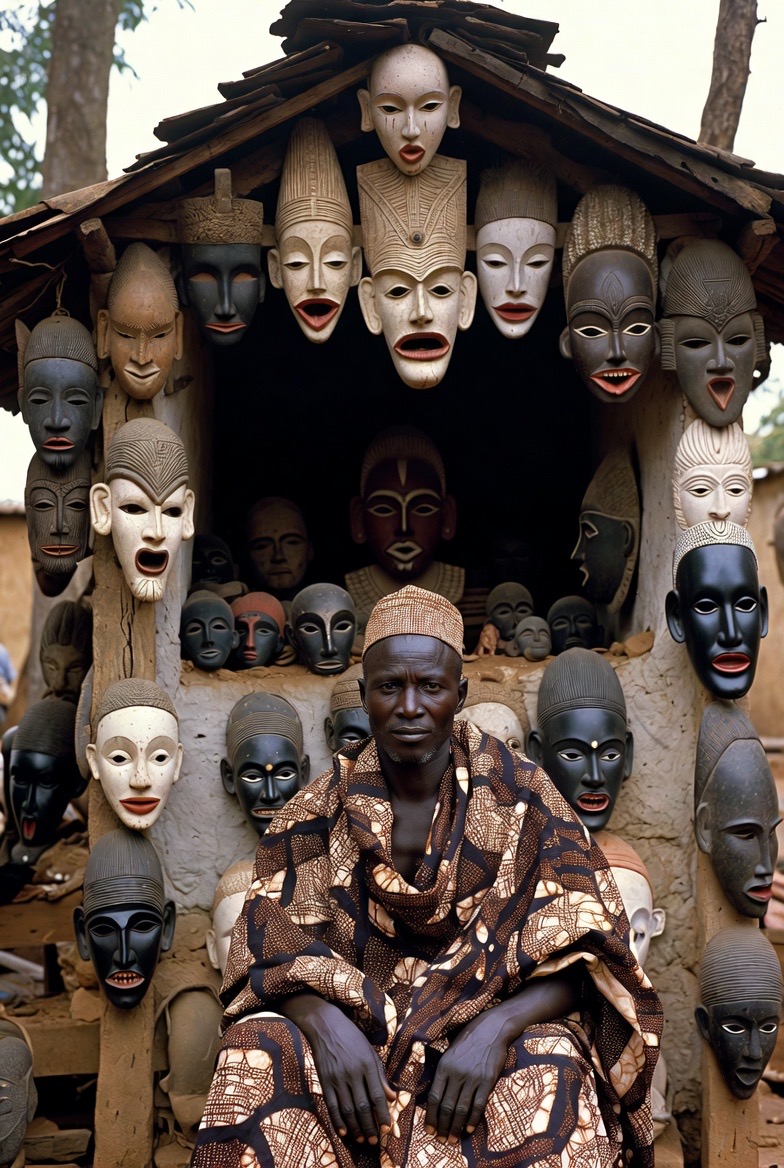
At the time when Nnamdi was still in senior high school, during this time that I tell you, people desperate to become rich sought the assistance of native diviners who lived in far away villages or forests, dressed in tattered clothes and operated in makeshift plank houses, decorated with skulls of various animals and bones, diviners whose half of their faces were covered in nzu and their eyes circled with uri and their heads shaved this way or that, men who wore hides or a piece of wrapper around their waists and chewed bitter herbs endlessly. At this time, men would visit these kinds of diviners who were themselves wretched but could make a rat richer than the bishop of the church where it lived or a street beggar rise to stardom by the wink of an eye. Some of the men that visited these diviners were men who had love for women and wanted to impress them, so they would visit the diviners and sacrifice the heads of their mothers or fathers, and each morning, millions of naira notes would appear under their beds. Some would gift confectionaries to kids returning from schools, turn them to fowls and haul them to the forests in exchange for car trunks filled with dollars or pound sterling or naira notes, millions of them. It was around this time as we now know, that Nnamdi’s father who was into the business of motorcycling sought riches.
For years Nnamdi’s father had been in this business, all he did every morning was wake up, and drive about town with his motorcycle, transporting passengers to wherever they wanted. At the end of the day he would account for two hundred naira or three hundred naira if luck was on his side. The business was a hectic one for it brought headache or pneumonia as he worked under the sun or in the rain. The good thing was that he got to transport all kinds of people; children, adults, the obese and the voluptuous women whose breasts jiggled and bounced at his back as he rode, forcing him to forget that he had family at home.
Then came a day that Nnamdi’s father took a man to a place called Osopong, to a compound filled with small, small huts and whose over ten trees therein were decorated with skulls and shells and bones and pieces of cloths. After this first trip, more came. Each time he conveyed some of his passengers to these kind of places, especially to Osopong, he would sit on a bench at the extreme of the compound and eavesdrop as the passenger deliberated with the diviners, telling them about this or that problem, or paying obeisance for wealth received, bringing forth, gifts of rams and goats and cows and drinks and money.
So one day, Nnamdi’s father decided that enough was enough. He had brought a passenger, bearing gifts of a ram, tubers of yams, a keg of palm wine and some money, to thank the gods of the diviners for wealth unthinkable given to him. The men preferred travelling by motorcycle for the road leading to Osopong wasn’t motorable. As they were coming, his passenger had filled his ears with stories of how poor he used to be, how a landlord threw him out of his apartment and he couldn’t afford his kid’s tuition, but in less than three months since visiting the diviners he was building a mansion, had a thriving business and all. So when the man finished paying his obeisance, Nnamdi’s father approached the diviner.
‘Excuse me, oga,’ he called. ‘Please do not look at me with anger. I didn’t from my house intend to meet you, but seated there, I reminisced over my life and decided that enough is enough. You, who has blessed countless people before me, with wealth, I beseech you to look upon me with mercy and grant me wealth.’
The passenger that he had brought heard everything he said, he excused himself and went to sit on the bench which Nnamdi’s father had been sitting on. Nnamdi’s father said to the diviner, ‘I want to be wealthy beyond what the eyes can see and the mind can fathom.’
‘You have come well. Sit.’ They sat on stools, facing each other. The place where they sat was under a massive tree, under which rested a huge mask, it was said that the mask could talk to the ones who had come to ask it of favour. On the mask were feathers from fowls, blood from chickens and cattle, there were half filled bottles of gins and various foods dropped before it. The diviner was a man in his late fifties, dressed in white linen cloth, with nzu painted on his face and neck and body.
Then in a husky, frightening voice, the diviner roared, ‘I know you! I know that your heart is troubled with desire for wealth. Your name is Innocent. You come from a humble background. Your father, I must tell you, died of hunger. He was a lazy man. The father of your father died a brave warrior in his time, he died in a battle, but he was not wealthy either. Listen, Innocent, your lineage is one to be of humble feature, you were not created by the Supreme Being to know wealth.’
‘And how come that is?’ Nnamdi’s father asked, anger ripping out his heart, ‘how come such wickedness and treachery from God? That some would be created to be rich and enjoy the world, while others like me created to enjoy penury?’
‘Penury is a virtue. It is a gift. Only if you can manage it well. What matters in life is happiness and peace of mind, be you in wealth or in poverty—’
‘Poverty is not my lot. I refuse it. I ride okada from morning till night, under the sun or in the rain, striving to make ends meet, yet they don’t meet. I want to be wealthy.’
‘Look, my friend, around here, all you see here are symbols of a deity rich enough to spare. Whatever you want can be granted you.’ Nnamdi’s father looked around and just then his eyes were opened. He saw, countless people, numbering over a hundred, chained hands and feet, they were engaged in various activities, some, cooking, others pounding fufu, others fetching firewood, most of them working on herbs for medicine, others nursing wounds. They looked dead yet alive, their hearts ripped out, yet they were breathing. Their heads the size of ukwa, and their hands long they could reach anything while they remained chained to their spot.
As Nnamdi’s father beheld these, he could, at same time hear the sound of a gong sounding,
…Ko nge nge nko
Ko nge nge nko
Nge ko Nge nge nko….
The vision was lifted and he could see the compound the way it was, the people on the benches, the trees decorated with charms, chickens roaming, goats bleating, the diviner, opposite him, seated, watching and waiting.
‘Who were those people?’
‘Which people, my friend?’
‘I saw people chained—’
‘What the eyes see is too many to fathom by the mind. Pay no heed.’
‘What steps must I take to have the world in my palms?’
‘You must bring ten thousand naira, a goat, a piece of white cloth, a cockroach, alive and in a bottle, seven kola nuts and some hairs from your head.’
‘I can get a goat. I own only one. I can get a piece of white cloth from my wife’s. I can get cockroach for my house is filled with thousands of them. I can cut my hair and give you here and now, but for ten thousand naira, how can I lay my hands on such money. I have never counted ten thousand naira in over seven years.’
‘But you must find it. The sooner, the better.’ Nnamdi’s father looked around. He went to the passenger he brought to the place and to him, said, ‘Friend, do me the honour of lending me ten thousand naira. I will pay as soon as my wealth is in my hands.’
‘No. I am sorry I can’t. One does not borrow to make a sacrifice.’ The passenger looked away, avoiding his eyes. Nnamdi’s father went back to the diviner, before the diviner was a huge plate filled with naira notes, over fifty thousand naira, gifts from subjects who had come to pay obeisance. Read full story in The Munyori Literary Journal.