Do you remember long ago, when Pa Ozo’s daughter – the one who was in Port Harcourt all those years doing tailoring – returned to the village, and all the women had to call a meeting and device means of holding their men tied to their wrappers? I do not mean his second daughter who is tall and fair and has a flat backside like old slippers. I mean the first one, the short one with large nyansh, the size of a hummer jeep; and bosom so protruding and full of milk that she could suckle a hundred soldiers fighting in a civil war – yes that is the one I am talking about. I wonder if you remember now.
Well, you should know her.
Have you forgotten she returned to the village and set it ablaze? It was the year 2009. Barrack Obama was already the President of America, and she came back with plenty-plenty stories. She said she travelled to America and was part of the Barrack Obama campaign; she even had lots and lots of polo-shirts with Obama’s face and The Change We Need inscribed on them. It was later we found out she was in Port Harcourt all the while and that she never left the city nor her tailoring. We found out she got engaged to a Calabar man who ran away because, we heard, he said she could not stop doing it to him every day and every night; at their room, in the sitting room, at the kitchen, at her shop, at his workshop – everywhere, until the man abandoned his things and left town.
So, when she returned to the village with stories of America and Obama, we knew there was trouble; we knew that men would soon start selling all they had to buy her drinks at Papa Ejiofor’s shop and nkwobi at Nwanyi Imo’s eatery. We knew that soon, there would be fights and quarrels among the men. That our women would queue in front of Pa Ozo’s house, demanding she returns to wherever she came from.
Do you remember the day she came back? It was early evening. She came in a lorry, with all her load – two sewing machines, cooking utensils, furniture, bed, everything.
While she unpacked, news circulated that Ama was back, and women came to see her.
They held her, turned her about this way and that, to weigh how she had changed, how much she had changed. They marvelled at the size of her upper chamber and giggled in adoration at the size of her down chamber, but they knew there was going to be trouble if this woman was of easy virtue.
While they walked back home in groups, they discussed her. What woman of good virtue would have those sorts of endowments, tell me? They asked themselves. Tell me, is it not by too much doing and doing that a woman’s things enlarges that much?
Of course, you are right, Mama Ezinne. You are right, Mama Nkechi, else, how could she have buttocks so massive they could break a wooden bench, eh?
Bia, is it not Ama of yesterday? When she left for the city, she was like the figure ‘One’.
One like this my finger. True. So, how did she manage to develop those massive endowments if not for too much doing, huh?
And on and on the conversation continued all around the village until the men heard and cleaned their ears. The next morning, it was as if someone blew a whistle. They trooped to Pa Ozo’s compound to see his daughter whom their wives talked about all night, while adding small-small threats here and there to warn them not to dare think of looking at this city woman, talk more of winking at her.
As they gathered, each greeted Pa Ozo who already had a bottle of Schnapps on a table. They asked of his health and talked of how the harmattan was becoming so fierce that it could kill. Then, they poured themselves some Schnapps and thanked God for granting his daughter – whom they hadn’t seen – a safe trip. When Ama finally came out of the house, carrying the heap of clothes she wanted to wash, Pa Ozo knew that his daughter was going to cause him a heart attack, for the men all stopped drinking and talking. They stared, mouth open, flies feasting on their lips – they all had intentions.
Ama smiled broadly at the men in greetings.
They said no. Did she forget her manners in the city? How could she greet them standing far away?
Come, come our daughter, bia ebe a.
Ama approached and genuflected for each of them. They patted her back, rubbed her shoulders, squeezed her arm, and smiled in delight. They could not hold themselves, for she was wearing a very short skirt – the back of the skirt was lower than the front because her massive buttocks had taken most of it. She was dressed in black singlet and most parts of her bosom escaped the front and the sides of the singlet and was causing the men to swallow all the saliva in their mouths. Some of them hurried to the backyard to ease themselves, and most excused themselves and went home. Pa Ozo knew he would have to speak with his daughter, else she would be lynched in no time by village women.
A few days later, Ama rented a large empty shop along the village road. It was on an isolated land and once served as a chemist shop. She put up a big signpost that read Obama Talorin Shop and put two of her sewing machines in it. Then, she travelled to town and bought bales of various clothing materials, and displayed them in her shop. She also divided the shop in two with a thick pink curtain so women could use the inner section for fitting.
II
The first day she started work in her shop, a man came. He said he had come to have his measurement taken; he wanted to sew a trouser for the age-grade meeting and wondered if Ama could do it for him. Ama told him she wasn’t into men’s designs.
The man said, no, of course no. How can you be in the city all these years and not know how to design men’s clothes? Come, come, take my measurement ozugbo.
Ama refused.
He sat, grumbling, disappointed. He told Ama that the city had treated her well.What did you eat over there? Ha, what kind of drinks do they take over there that could make a person’s body so soft.
He patted Ama’s arm. Ama shook him off.
Mind yourself, she said.
He was ashamed. She stared him down. He dipped his hand into his pocket, brought out the money he had for his design and placed it on the table. Ama smiled, took it, and sluggishly placed it deep in her bosom and patted her breasts – they jumped up and down for they were massive things. The man shifted uncomfortably. A woman was approaching.
Ngwa, you must leave now, Ama said.
The man stood reluctantly. His hand brushed Ama’s arm – there was intention.
In the evening, another man came. He was in his late forties and had a wife and three children. He was the richest man in the village who traded in timber. It was already dark, and Ama had lit a hurricane lantern. He said he came to say welcome to her. Had she forgotten when they were small and how they used to play on their way returning from the village school? Ama could not remember.
Wait, chelu, have you forgotten one night, during moonlight hide and seek game, we hid at the back of Mazi Nduka’s plantain tree and touched each other?
Ama remembered. You are Asari?
He nodded.
His eyes twinkled like the stars as they exchanged stories. He told her stories of how he travelled far into the forests of Cameroon to buy timber. He told her funny stories and she laughed gaily, her voice hoarse, yet to Asari’s ears they were melodic, not like that of his wife – he sighed.
They talked far into the night.
She said she had to go. He insisted he walked her to her father’s compound. He was her father’s friend. Did she not know that he, Asari, supplied her father the timber he used in roofing his new building, and her father paid in instalments? She thanked him. They walked down the bushy path as the crickets chirped in discordant tunes. Around the village swamp she said she was feeling cold, and he rubbed her shoulder warmly. Then, his hand stayed; after a few steps, he rubbed again.
That night, Asari could not sleep. He stayed awake all through, thinking of the city
woman and her endowments; he knew he had to move fast before another outwitted him.
The next day, he bought her some fresh meat from the butcher. She would have to prepare egusi soup with the meat, he said as he gave her some money.
You need money to settle down in this village. You need some kerosene; you know in the city you are used to electricity....
She thanked him.
He would come back in the evening and escort her to her father’s compound, he said. It would not be wise for a city woman, new in the village to walk down the paths alone, at night, mbanu!
When Asari left, Papa ND brought his wife to Ama’s shop to pay for her design. Papa ND
was the stingiest man in the village, and everyone knew he followed his wife to the market to be sure she did not defraud him. Ama gave the woman a fashion magazine, she made her selection, and they agreed on a price – N1200. Papa ND paid reluctantly to his wife’s surprise and delight. He had never paid that much for a design since they got married – and that was twelve years ago. They left the shop, but he returned – less than fifteen minutes later.
Papa ND told Ama he came back to thank her for agreeing to sew for his wife.
Ama told him it was her job, why thank her?
He said well, he knew it was her job, but if you thank the akidi woman, she would prepare another porridge for you. He stammered, and with his eyes on the floor, said he liked her. Ama’s face grimaced in disappointment.
Why? She asked.
He stammered inaudibly. She didn’t know, he said, but he was at her father’s compound the day she returned and could not keep her off his mind ever since.
She smiled and thanked him.
It was the most beautiful smile, ever. His manhood nodded in his trousers. He had never felt that young and virile. He asked if he could come back in the evening so they could talk.
She said yes, but that she was hungry now.
He dipped his hand into his pocket, brought out some money, and gave her a thousand naira.
She said, Ah, just that? What will you do with all the money in your pocket?
There was a piece of dirt on his hair. She stood and picked it off and smoothened his hair. Then, she collected the money in his pocket, all of it.
He smiled sheepishly and said, thank you.
In the evening, Asari brought some oranges, bush meat prepared in peppery sauce, and four bottles of ‘33 Export. They ate and talked and giggled in delight. One or two men, on their way to Ama’s shop heard the laughter. They approached and heard it increase in tempo and turned back, each passing the other on the road and giving one or two excuses why they were on that path, each knowing what the other knew, wanting what the other wanted.
When the bottles of beer were on the ground, empty, their contents now wreaking havoc in the heads of their consumers, Asari’s stool began to shift on its own accord towards Ama’s stool. He told her of the road to Otukpo that was a death trap and how Tiv men were the highest womanisers in the whole wide world. She laughed at hearing that. He laughed at her laughter and rested his hand on her exposed laps. She was quiet. His hand moved up, exploring, searching – there was no resistance. Then, he rubbed the flesh of her laps and aahed, but he pulled away fearfully. She took his hand, gently; she placed it on her underwear and guided his finger through the side, to the jungle place, to the entrance. He was surprised. She was bold.
Touch it, Ah… this way.
She guided his finger; she stroked, he stroked. He stroked till her bell began to ring, he could hear it, he could smell her womanhood, he could feel her heat. She leaned back on the wall and parted her legs. He tried to withdraw; she held his hand and pushed deeper. He became bold.
Ama’s head was now inclined this way, her shadow cast on the wall before her by the lantern on her Butterfly machine, her mouth open, sounds escaping out of their own accord, discordant, muffled, loud, muffled. She leaned towards him, taking his head to her bosom. His eyes opened wide in wonder and gratitude. She released the breasts from their cage; they were so massive and so beautiful, he nearly lost his breath. He took one nipple into his mouth and bit and suckled; he took the other into his mouth.
His hands were now on the breasts, hard palms that had known hard labour, pressing, demanding. Ama’s hands unzipped him, found him ready and stroked, up and down, this way and that way, the fluids lubricating, enhancing her duty – there was no resistance.
Ama bent down and took the massive penis into her mouth and swallowed and gagged and laughed. Asari fell off the stool. His head hit the sewing machine. It was painful, but there was no need standing up. Ama knelt beside him and continued with her duty, making sure her hands found his nipples, twisting this way and that.
A man was close by. He could not see them, but he could see the shadows cast on the wall, he could hear the moans; he had never ever heard such moans in his lifetime.
The next evening, the man who listened to Ama and Asari told his two friends what he heard and what he saw; he embellished the story with lies here and there. They gawked in surprise and envy and delight.
They also came, one after another, each not knowing the other had come.
I was on my way from my rice farm and thought I should stop by to check if you are acclimatising well, one said. He offered Ama some money; Ama accepted and thanked him.
The other brought some yams. He had just harvested yams and thought she needed yams. Another brought coconuts. Another brought groundnuts. Another brought palm wine, freshly tapped. Ama took everything.
On her way from work, Ama stopped at Nwanyi Imo’s bar to buy a bottle of gin for her father. A young man was in the shop. He was one of the few young men who had refused to leave for the city, yet he wasn’t useful to the village. He drank and smoked and messed with virgin girls and gave their fathers heartbreak. His name was Silas and at seeing Ama, his mouth threw open.
Why not sit and have a drink with me? he said. Ama declined and thanked him. He insisted and grabbed her hand affectionately, but the grip was tight. Please sit, nwanyi oma, he said. Please, don’t deny a young man the opportunity to hear tales of the city.
She sat.
Nwanyi Imo served a plate of nkwobi and a bottle of Gulder beer. Silas asked questions, she answered. She said she had to go.
Ka chi fo, she said.
He escorted her to the village junction. Asari was on his way to Nwanyi Imo’s bar. He saw them together. The three stood and stared at each other, briefly.
Silas, how are you? Asari asked.
Silas said nothing. He told Ama to have a good night. He hurried back to the bar.
The next day, Silas brought Ama a watch. It was a cheap watch, but did it matter?
When he left, Papa ND came. He said he came to know if she was well. She said she heard he was stingy. He smiled and said he must go, but he gave her some money to prove her wrong. When their hands touched, she held him.
You must give a woman more money.
She stood, glanced to be sure no one was about, dragged him to herself, and pressed her body to his. Her bosom caused his heart to quicken. She dipped her hand into his pockets and took all that was there. He smiled and thanked her.
I should come in the evening, please, he said.
You can come, but please, bring some things.
In the evening, the moon had receded. The frogs croaked loudly in the swamps around the path. Papa ND brought a sack containing two tubers of yam, a bottle of costly gin, and a pack of combs of various sizes. Ama inspected the gifts and thanked him.
He was shy. He didn’t know how to begin. Ama suspected that Asari might be coming. She asked him to leave because she wanted to work. The old man sat put. So, Ama stood and asked him to follow her. She took him to the inner section of the shop and touched him till the man screamed in delight.
Sheee, she said, placing her finger on her lips, pouting.
She brought out one of her breasts and asked him to put his mouth there. He was shivering, but he did as she instructed. She stroked his head with one hand and touched his manhood with the other and in less than a minute felt his ejaculation on his trousers.
Ah, agadi, you can’t even stand me. Now hurry and go, your wife is waiting.
He was shivering as he parted the curtain and peeped. Then, he hurried away, finished, grateful. A few yards away from her shop, he heard someone whistling into the night. He ducked into the bush. He did not want Asari's troubles.
Ama stood and hugged Asari. He wanted to know what she was doing with Silas the night before.
She said it wasn’t his business. Was she his wife? Did he think he had rights over her?
No woman had ever talked to him that way. He was enraged but said nothing.
You can leave if you think I should not greet people in this village because you are Asari … you are not even my boyfriend.
Asari was disappointed.
What would it take to make her his girlfriend?
She said he needed to take care of her.
He said he would surprise her. Ha! Just wait till morning, he said.
He said they needed to close the shop. She locked the door from inside. They were alone. She smiled at him. She pushed him to the wall and unbuttoned his shirt. She kissed his nipples. This one first, that one next. He danced from one foot to another – that was new. She kissed his dusty neck and his left ear, while his hands smooched her breasts, fumbling, trying to bring them out. She dragged him to the other side of the divide. She unrolled a mat and made him lie down. What she did made him giggle while he dreamt of what to give her to make her his girl – a new sewing machine for she was already saying her own was old? A bale of cloths? He could afford that; or he could sell one of his motorcycles. He wondered if he should give her a new mattress, for her shop, for their plays. But how could he transport that to her shop without the villagers knowing? At that point, she said she would teach him something. She removed her skirt and lay down and brought his head to her womanhood. He licked and licked, and nothing ever tasted so good. Silas stood by the window, listening, filled with anger and envy.
III
The stories were everywhere; the rumours increased. Women were going berserk. Pa Ozo had talked with Ama twice, and she had denied everything.
Then, women began to meet at night to plot, for their husbands no longer came to their beds or gave them feeding allowances, and they knew where the money was going to; they needed to act. Someone suggested the best thing to do was to lay ambush on Ama while she returned from her shop. Another said they should hide in the bush around her shop in the evening till they caught any of their husbands with her, so they could storm her shop and break the door and disgrace her. But that was a dangerous plan for if she was caught with a man, she and the man would be dragged round the village nude – no woman wanted to have her husband disgraced, for there were possibilities that it could be anyone’s husband. So, the threats hung in the air, and the suggestions hung in the air – there was no resolve.
Asari bought the mattress and sent it to Ama’s shop. The day before then, he brought her the sewing machine. Ama was teaching her new shop attendant, a teenage girl, how to cut materials to size, when the lorry brought the family-sized mattress. The lorry driver called her to one side and told her in whisper who had paid for it – the attendant heard. When work was dismissed, the news circulated in the village. The plot was re-hatched.
The next evening, Asari came to celebrate with Ama, to confirm that she was now his girlfriend. Earlier, he had dreamt of how the mattress would enhance their lovemaking.
He had fantasised about her and seen her firm body on the soft mattress – he had seen himself kissing her, tracing his tongue from her mouth to her neck down to her cleavage. He had seen her tickle him and pin him on the bed, the softness of the bed adding to his pleasure as her hands traced contours on his hairy chest and her mouth enclosed his nipples, sucking, biting.
As he walked, whistling to himself that night, he fantasised. It was eight o'clock in the evening. The women knew who whistled that way. They were fifteen, twenty, uncountable; they were in the bush, holding pestles, machetes, cooking knives, sticks. The lantern in the shop was dim, emitting just a flicker of light. They had come in good time, for Ama was not on her machine in front of the shop, she was inside. They were sure she was with a man, but they had not heard her moans. Rumours had it that her moans were louder than the sound of canons, so they wondered if she was with a man at all.
Asari whistled as he walked. He got to the threshold of the shop. The new Butterfly sewing machine he bought was glistering in front of him, a cut Ankara material on top of it. The new lantern he bought for her was lit and dimmed. He could see shadows on the wall, shadows of the lantern, of the machine, of the cloths, of everything in front of the shop. Then, he heard a ruffle and threw open the divider and saw them – Ama was on top of him on the mattress he bought with his hard earned money, her skirt hitched up, rocking him hard, hard, up and down. His hands were enclosed round her waist, professionally, skilfully, guiding, leading her deep, deeper. Their shadows were cast on the wall. Ama’s mouth was half open in delight, and she was moaning softly but it was deep, moans filled with passion, more than he had ever imagined. Her bare breasts dangled in front of the man’s face. He had never known them to be that massive.
Asari’s legs became weak. He did not stand there for up to a minute, for shortly after he threw open the thick curtain, they stopped.
It was Silas.
Silas had a jubilant smile on his face. Asari was sure Silas had winked at him. Then, it happened. He grabbed the charcoal iron on top of a nearby table and lounged at her … it all happened in one second, not more.
The women heard the screams.
The men, over six of them had also been hiding here and there, waiting, all in possession of their gifts. They emerged from their hideout and unconsciously ignoring each other’s presence and the women, hurried into the shop. There, they found Silas' head split, for Ama dodged and the weapon hit Silas instead. While they tied a shirt round Silas' head, someone turned Asari who had been lying face down, and everyone saw, mouth agape, a tailor’s scissors in his big stomach.
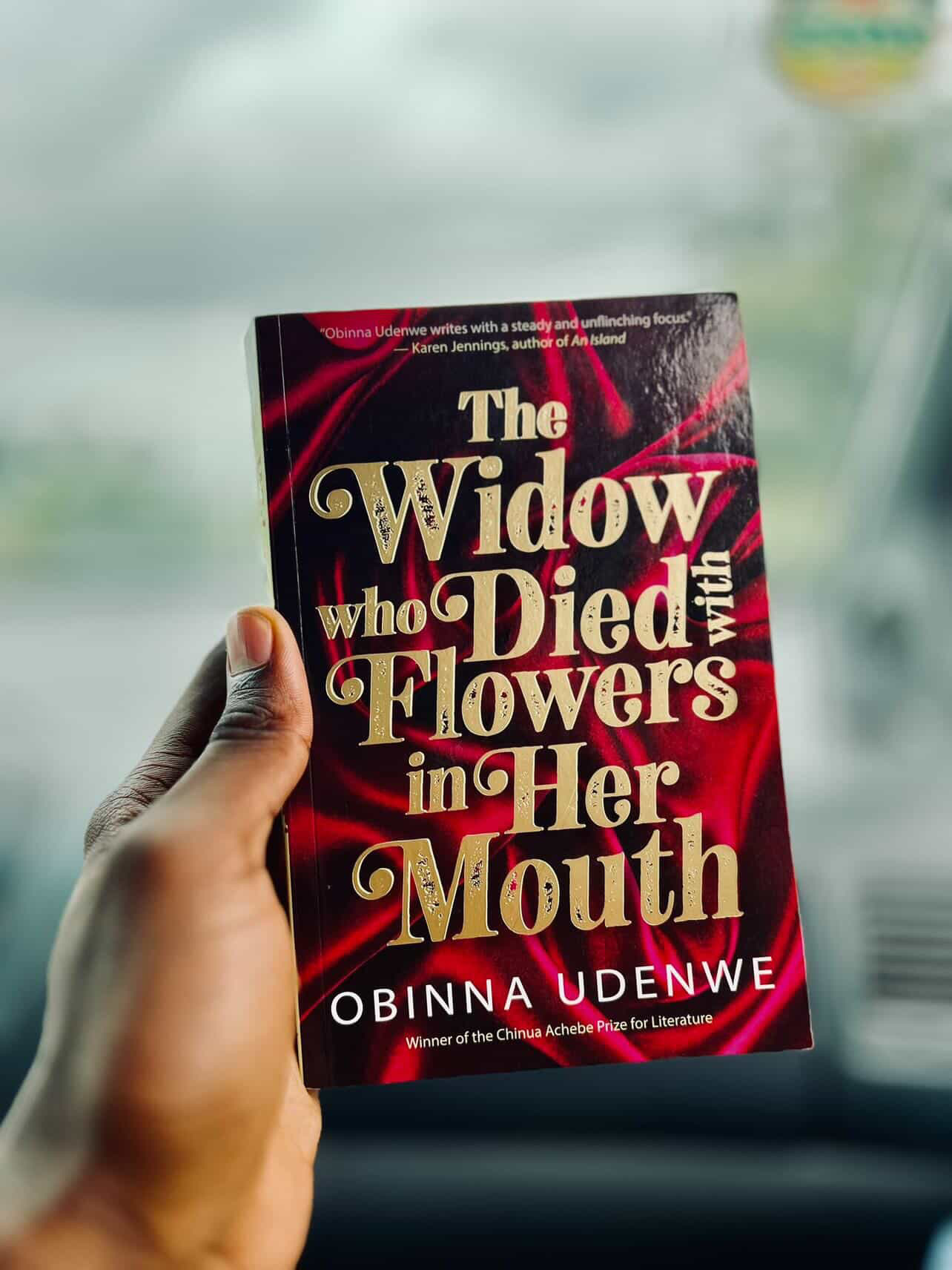
Obama Talorin Shop is published in the collection, The Widow Who Died With Flowers in Her Mouth.